
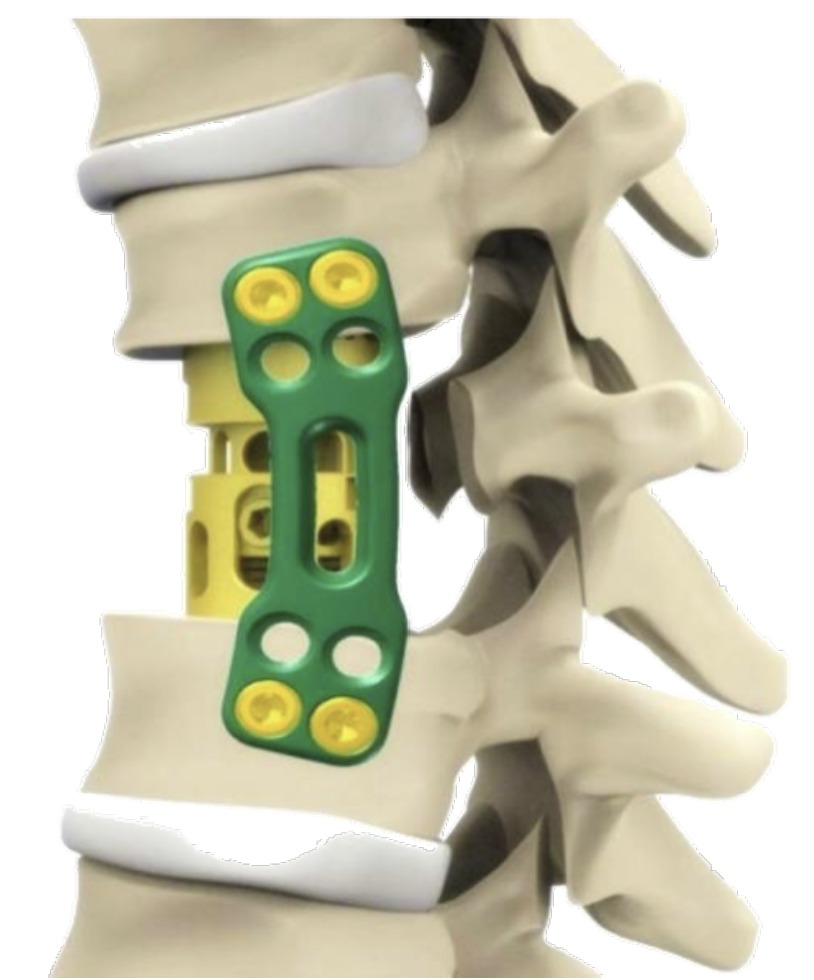
3D-printed vertebral cages are built layer by layer, which allows an internal porous structure. Material, pore geometry, footprint and surface finish are the specifications to compare.
Additive manufacturing builds a cage from a digital model instead of machining it from solid stock. The practical consequence for a buyer is that internal geometry becomes a stated specification rather than a fixed property of the material.
What the porous structure is for
The catalogue describes a porous internal architecture in the 3D-printed cages. A porous structure gives bone a surface and volume to grow into, which is why pore size, porosity and strut thickness appear in the technical description of these devices.
Material and how the cage is seen on imaging
Titanium alloys are the materials usually named for additively manufactured cages. When comparing two designs, ask how the cage appears under intraoperative imaging and whether the design includes markers, because position confirmation is part of the workflow.
Product families listed
The spine catalogue lists 3D-printed cages for both the lumbar and the cervical route. They are supplied alongside the conventional cage lines, so a single case may combine a printed cage with a fixation system from the same catalogue.
Specification checklist
- Material and manufacturing method
- Pore size, porosity and strut dimensions
- Footprint length and width, and the size range available
- Insertion profile and lordosis angle
- Surface finish of the endplates that contact bone
- Sterile presentation, single-use designation and lot identification
Advanced Modern Sciences works with Bonetech Medisys for spine fixation systems and fusion cages. Comparing printed cages starts with the pore geometry and footprint, since those two points separate one design from another.
Common questions
Why does a 3D-printed cage list pore size?+
The printed process creates an internal porous architecture, and pore size, porosity and strut thickness describe the structure bone encounters inside the cage.
Which routes do the printed cages cover?+
The catalogue lists printed cages for the lumbar route and the cervical route, supplied alongside the conventional cage lines.
What makes two printed cages comparable?+
Compare material, pore geometry, footprint and size range, insertion profile, endplate finish and sterile presentation.
Looking for medical products for your facility?
Contact our Riyadh team to discuss availability and supply.
Contact Us